|
| M.Theiss - Hard- and Software for Optical Spectroscopy | ||||
| Home | Products | Applications | Support | News |
OJL interband transition model for amorphous materials - a brief tutorial
OJL application example: ITO on glass
This section describes the more advanced example of an ITO layer (deposited by reactive sputtering in an Argon/Oxygen atmosphere) on glass (microscope slides):
|
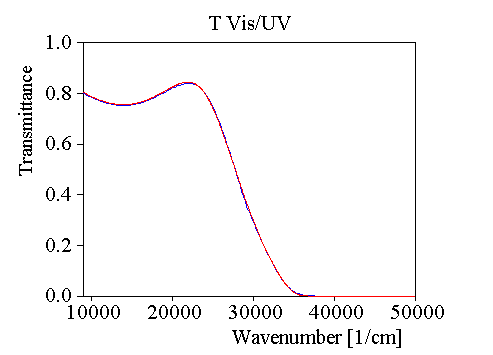
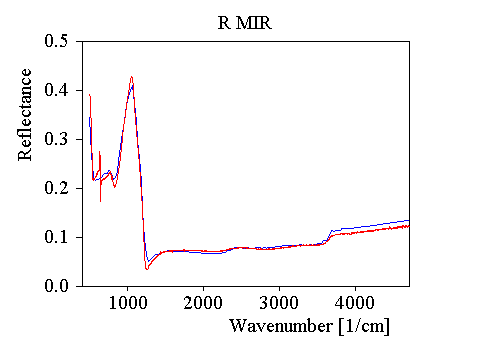
Once more, three spectra have been recorded: transmittance and reflectance in the NIR/Vis/UV regime (from 9000 to 50000 1/cm, i.e. 1100 to 200 nm wavelength) and reflectance at 30 deg angle of incidence in the mid infrared (s-polarization, 400 ... 5000 1/cm). For the glass substrate an imported, fixed dielectric function has been used.
The model for the ITO dielectric function is composed of four parts: a constant and real dielectric background, two OJL interband transition models and a Drude model for free carriers. The following fits have been achieved:
|
The dielectric function obtained from the fit is the following (real part in blue, imaginary part in red):
 |
The fit parameters are given in the following table:
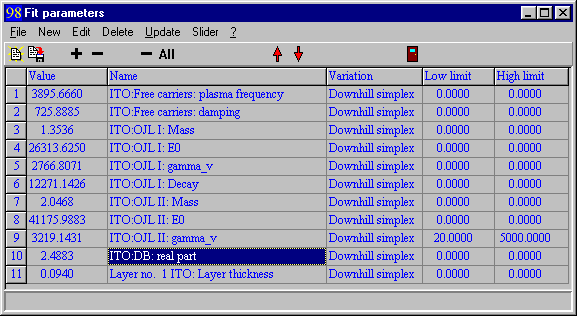
Note that in this example much larger gV values are found compared to the BiOx case shown above.
The SCOUT_98 configuration of this example is available on the download page.
This example was prepared by T.Lange (I.Phys.Inst., Aachen University of Technology). Many thanks!
Responsible for this page: webmaster@mtheiss.com